 Mount Vernon
 Why Alger's Climate Is Hard on a Deck
Alger sits in the rural, tree-covered stretch of Skagit County between Mount Vernon and the county line, close enough to the Samish Bay and Puget Sound shoreline to catch salt-laden air on a regular basis, and shaded by enough fir and cedar cover that moss and algae have every advantage they need. That combination — salt air, driving rain off the water, and a moss season that runs longer here than it does further inland — is exactly what wears out an outdoor deck faster than homeowners expect.
Salt air isn't just a coastal-town problem. It travels on wind, settles on any exposed surface, and works its way into fasteners, connectors, and any exposed end grain. Combine that with the driving, sideways rain that comes through this part of Skagit County in the fall and winter, and you get moisture pushed into places a deck was never designed to shed it — under rail posts, into ledger connections, and between deck boards that weren't gapped correctly in the first place. Add a shaded, damp yard and you get moss and green algae film establishing itself on the deck surface within a season or two if the material and the build don't account for it.
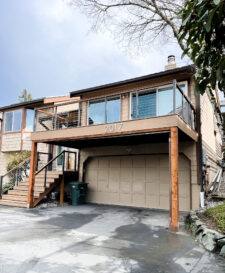
What Alger Homeowners Actually Need From Their Decking
Given that climate, a deck in Alger has to do more than look good on installation day. It needs to hold up over years of wet-dry cycling without cupping, splintering, or rotting; it needs a surface that doesn't turn into a skating rink once moss and algae take hold; and it needs hardware and fasteners that won't corrode or work loose from repeated soaking. That's the case we make for composite decking here — not because it's trendy, but because it's genuinely a better match for this specific climate than most of the alternatives.
- Moisture stability — composite boards don't absorb water the way wood does, so they don't swell, cup, or splinter as the weather cycles through wet and dry stretches.
- Surface traction — most composite boards are manufactured with a textured, capped surface that sheds moss and algae growth better than bare wood grain, and cleans up without sanding.
- No annual refinishing — no re-staining, no sealing before the rains come back, which matters a lot when your deck is shaded for most of the day.
- Consistent long-term appearance — color and texture stay uniform board to board, which matters on a material that's going to be rained on eight or nine months a year.
Composite vs. Other Decking Materials
We install composite because, weighed against the realistic maintenance a homeowner will actually keep up with, it holds up best in this specific climate. That said, every material has trade-offs worth knowing before you decide.
| Material | Moisture behavior | Moss/algae resistance | Upkeep | Typical lifespan |
|---|---|---|---|---|
| Pressure-treated wood | Absorbs water, prone to cupping and splitting over time | Low — rough grain holds moss and algae | Annual cleaning, periodic re-staining/sealing | 10–15 years before major repair |
| Cedar/other natural wood | Better dimensional stability than treated pine, still absorbs moisture | Low to moderate | Regular sealing to prevent graying and rot | 15–20 years with upkeep |
| Capped composite | Very low absorption; core is shielded from direct moisture contact | High — textured cap resists staining and growth | Occasional wash-down, no sealing | 25–30+ year warranted lifespan |
| Uncapped/older-style composite | Some absorption at the core, more prone to mold in shaded, damp settings | Moderate | Periodic cleaning, more sensitive to standing moisture | Shorter warranty coverage than capped products |
This is exactly why, when we talk to Alger homeowners, we steer toward fully capped composite products rather than older uncapped composite or bare wood. In a yard that stays shaded and damp for long stretches of the year, the difference in how the material sheds moisture and resists mold isn't cosmetic — it's the difference between a deck that needs real attention every spring and one that doesn't.
What About PVC Decking?
Cellular PVC decking is fully synthetic, with no wood fiber at all, so it has effectively zero moisture absorption and excellent mold resistance. It can be a reasonable option for a fully exposed, low-shade deck. Where we're more cautious with it is appearance and feel — PVC can look and feel more plastic than a modern capped composite, and some PVC boards are more sensitive to temperature-driven expansion and contraction, which affects fastening spacing and detailing. It's a legitimate option; we just make sure homeowners understand that trade-off before choosing it over composite.
What a Correct Installation Actually Involves
Most decking failures we get called out to fix aren't a material problem — they're an installation shortcut that the climate eventually exposed. A composite deck built right in Skagit County conditions has a few non-negotiables.
Framing and Flashing
The substructure matters as much as the decking itself. Joists need to be spaced and sized correctly for the specific board being installed — composite manufacturers publish span tables, and skipping them is one of the most common causes of a bouncy or sagging deck years later. Where the deck attaches to the house, the ledger board needs proper flashing that directs water away from the wall assembly and siding, not into it. This is the single most common water-intrusion point on any attached deck, and it's exactly the kind of detail that gets rushed on a fast job.
Fastening and Board Layout
Hidden fastener systems are worth the extra labor on a composite deck — they avoid the small pockets around exposed screw heads where water, grit, and moss spores like to collect. Board gaps need to be set to the manufacturer's spec to allow for thermal movement and drainage, not just tightened up for a clean look on day one. We also pay attention to end-grain sealing at cut boards and around posts, since a cut edge is the one place a capped composite board loses its protective shell.
Drainage and Airflow Underneath
A deck sitting low over damp ground, or built over a ledge with poor drainage, traps moisture underneath and gives moss, algae, and mildew a place to thrive even if the walking surface stays clean. Where the site allows it, we grade and vent the space under the deck so air can move through and water doesn't just sit there through the wet months.
Our Process for an Alger Composite Deck
- On-site assessment — we look at the existing structure (if there is one), the grade, drainage, shade pattern, and how exposed the site is to wind and driving rain.
- Material selection — we walk through composite board options and finish colors with the homeowner, matched to budget and to how much direct sun vs. shade the deck actually gets.
- Framing and code check — we confirm footings, joist spans, and ledger attachment meet current code and manufacturer requirements before a single deck board goes down.
- Flashing and waterproofing — ledger flashing, joist tape, and any necessary waterproof membrane go in before decking, not as an afterthought.
- Installation — hidden-fastener boards, correct gapping, picture-framed edges where called for, and properly sealed cut ends.
- Railing and finish details — post connections, baluster spacing, and any stair work finished to the same moisture-conscious standard as the deck field.
- Final walkthrough — we go over basic care with the homeowner and point out anything site-specific — shade patterns, drainage paths, or spots that will need more frequent cleaning.
Living With a Composite Deck in Skagit County
Composite decking is genuinely low-maintenance, but "low-maintenance" doesn't mean "no maintenance," especially with the debris load from conifer trees and the amount of rain this area sees. A little seasonal attention keeps a composite deck performing the way it's supposed to for decades.
- Sweep needles, cones, and leaf debris out of board gaps regularly — trapped organic matter is what actually feeds moss and mildew, not the board material itself.
- Wash the deck surface once or twice a year with a soft-bristle brush and a composite-safe cleaner to clear early moss and algae film before it takes hold.
- Keep gutters and downspouts directing water away from the deck, not onto it — repeated sheeting water over one section accelerates dirt and moss buildup there.
- Check railing posts and stair connections once a year for any looseness, especially after a hard winter storm cycle.
- Avoid pressure-washing at close range or high pressure — it can damage the capped surface; a garden hose and brush is usually enough.
Signs an Existing Deck Needs Attention
If you already have a deck in Alger and you're not sure whether it needs full replacement or just repair, a few signs are worth a professional look rather than waiting:
- Soft or spongy spots in wood decking, especially near the house connection
- Persistent green or black staining that comes back quickly after cleaning
- Visible gaps or rust at the ledger board where it meets the house
- Fasteners backing out, or boards that have started to cup or bow
- Standing water or slow drainage underneath the deck after rain
Any of these can usually be evaluated in a single visit, and it tells us whether you're looking at a repair, a resurface, or a full rebuild.
Why It Matters That We Already Work in Alger
A crew that only occasionally works this part of Skagit County will build to a generic spec sheet. A crew that works Alger regularly knows to size framing and flashing for the driving rain this area gets, to account for the salt-air exposure coming off the water, and to plan drainage and shade-management differently on a heavily treed lot than on an open one. We've built decks and handled siding work throughout the Mount Vernon area long enough to know which details actually matter here versus which ones are just boilerplate — and that shows up in how the deck performs five and ten years down the line, not just on installation day.
A Practical Cost Framework
Composite decking costs more upfront than pressure-treated wood, but the total cost of ownership over the life of the deck usually favors composite once you factor in refinishing labor and materials that wood requires. Exact pricing depends on square footage, board tier, railing style, and site conditions like grade and existing structure condition — we walk through real numbers during an on-site estimate rather than quoting blind, but the table above gives an honest sense of how the materials compare on maintenance and lifespan, which is where the real cost difference shows up over time.
If you're planning a new deck or need an honest read on whether your current one is salvageable, we're happy to come take a look. There's a free, no-pressure estimate form below — tell us a bit about your project and we'll get back to you with straight answers, not a sales pitch.